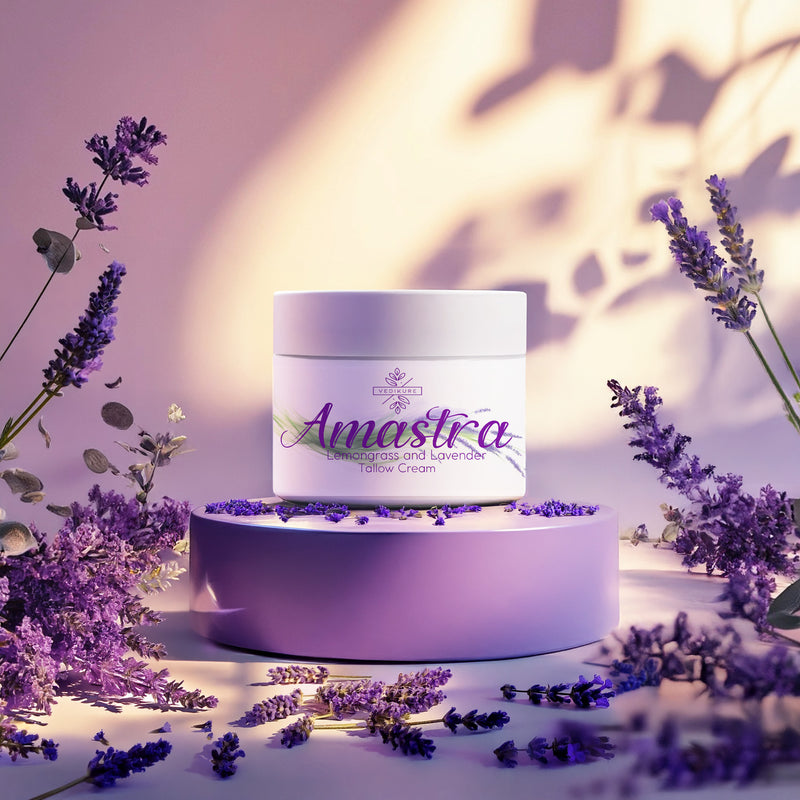


Beef tallow works, but for a narrower job than most people think. It's an occlusive: it forms a film that slows water loss, which makes it genuinely useful on dry, rough, or wind-damaged skin, mostly on the body. Past that, the clinical evidence gets thin fast. A 2025 review in the Journal of Cosmetic Dermatology analyzed 200 social-media posts promoting tallow and concluded that support for its dermatologic benefits "remains insufficient." If you have acne-prone or oily facial skin, most dermatologists suggest you skip it on your face.
That's the short version. Tallow is having a moment, and most of what's written about it is written by people selling it. So here's what holds up, what doesn't, and how to work out whether you're in the group it actually helps.
What beef tallow actually is
Beef tallow is rendered beef fat. The fat is gently heated so it separates from connective tissue, then filtered and cooled. What's left is a firm, white, near-odorless solid that melts at body heat. That's why tallow-based balms and creams feel solid in the jar and turn to oil on contact.
Chemically it's simple. Rendered tallow is essentially all triglycerides (esters of glycerol and fatty acids), and three fatty acids dominate the profile:
Oleic acid is the same monounsaturated fat that dominates olive oil. Palmitic and stearic are the saturated fats that make tallow firm. That's more or less the whole story. There are trace fat-soluble vitamins in there, but not in amounts that make tallow a meaningful source of any of them.
What the evidence actually says
This is where most tallow content goes quiet, so it's worth being specific.
In 2025, researchers published a cross-sectional analysis of beef tallow skincare claims in the Journal of Cosmetic Dermatology. They pulled 200 pieces of social-media content, 50 each from YouTube, YouTube Shorts, Instagram, and TikTok, then coded what was being claimed and who was claiming it. The findings:
- 82% of posts recommended tallow for skincare
- 61% showed financial bias, meaning the creator stood to gain from the recommendation. On Instagram that rose to 92%
- 80% of creators had no healthcare credentials
- Only 16% of YouTube videos cited any scientific source
- Dermatologists showed 7% financial bias, compared with 67–76% among non-physicians
The most common conditions tallow was recommended for were acne (29 posts), eczema (25), and psoriasis (12). The authors' conclusion was direct: "Despite growing anecdotal claims, evidence supporting beef tallow's benefits for skincare and dermatologic conditions remains insufficient."
That doesn't mean tallow does nothing. It means enthusiasm has outrun the evidence, and the loudest voices usually have something to sell. Us included. Keep that in mind while you read the rest of this.
Institutional positions line up with that. Cleveland Clinic dermatology resident Angela Wei, MD, puts it plainly: "currently, there isn't enough research to support the use of beef tallow in skin care." She adds that "there's not enough research on how well these are absorbed into the skin or if they provide meaningful skin care benefits."
Dermatologist Mika Tabata, MD, at MD Anderson, is more willing to grant the moisturizing case. "It's a very extreme moisturizer," she says. "For patients with super dry skin, I think it could be helpful." She still flags the gap: "beef tallow hasn't really been extensively researched."
The "it's just like your skin's own oil" claim
You'll see this everywhere, and it's the single most repeated argument for tallow. It's about half true, and the half that's false is the important half.
The overlap is real at the fatty-acid level. Human sebum and beef tallow both contain oleic, palmitic, and stearic acids. But sebum isn't just a bag of fatty acids. It's a specific mixture of lipid classes, and that's where the two come apart.
A 2025 review in the International Journal of Cosmetic Science puts representative human sebum at 31.3% triglycerides, 25.2% wax esters, 25.1% free fatty acids, and 13.6% squalene. Squalene is a lipid your sebaceous glands produce at concentrations found almost nowhere else in the body, and it's a meaningful part of what sebum actually does. Wax esters are the other signature component, and they're what give sebum its distinctive texture and staying power.
Published compositional profiles of beef tallow list neither squalene nor wax esters at all. That isn't surprising: tallow is storage fat from an animal's body, while squalene and wax esters are products of sebaceous glands. Different tissue, different job, different composition. So "structurally similar to your skin's own oil" overstates it. "Shares some of the same fatty acids" is accurate, and is a much weaker claim than it's usually made to sound.
None of this means tallow can't moisturize. It means the mechanism is ordinary occlusion, not some special biological match.
One nuance almost nobody mentions: oleic acid
Tallow is 36–43% oleic acid, and oleic acid has a well-documented effect on the skin barrier that rarely appears in tallow marketing.
A penetration enhancer is an ingredient added to a formulation specifically to loosen the skin barrier so an active can pass through it. Oleic acid is one of the most widely used ones in pharmaceutical formulation. It works by inserting into the ordered lipid layers of the stratum corneum and fluidizing them. This mechanism is established and well characterized in ultrastructural studies.
Two things follow, and they cut in opposite directions:
- If your barrier is already compromised (active eczema, cracked or broken skin, a recent chemical exfoliation), a high-oleic fat may not be the neutral, protective thing it sounds like.
- The disruption is largely reversible, but slower to settle than you might assume. In a 2023 study in Molecular Pharmaceutics, transepidermal water loss returned to near-baseline once the oleic acid was removed. But electrical impedance, a second measure of barrier integrity, "was not completely reversed even 24 h after removal." Treat this as a "be thoughtful about when and where" point, not an alarm.
On intact, dry skin on the body, none of this matters much. On inflamed or broken skin, it's worth knowing before you slather.
What tallow genuinely does well
Strip out the claims that don't hold and there's still a real product underneath.
The occlusion is the main event. An occlusive is an ingredient that forms a physical film on the skin to slow water loss. Tallow is solid at room temperature and melts at skin temperature, so the film it leaves behind is a persistent one. For very dry skin that single mechanism does most of the work.
It's also a decent emollient, which is a different job: an emollient fills the gaps between skin cells. That's why tallow makes skin feel smoother straight away instead of just greasier, and why it turns up in recovery balms for rough, damaged patches.
Then there's simplicity. A single-ingredient fat gives you a very short list of things to react to, and if you've had trouble with fragrance, preservatives, or twenty-line ingredient lists, that matters. Two caveats. "Natural" and "hypoallergenic" are not the same word. And beef allergy, while uncommon, is real.
Last, it layers well. Being an occlusive, it does its best work sealing in something else rather than acting alone. More on that in a moment.
Who it's for — and who should skip it
| Skin type / situation | Verdict |
|---|---|
| Very dry skin on the body — shins, elbows, heels, hands | ✅ Best case. This is where tallow performs |
| Wind, cold, or friction-damaged skin | ✅ Reasonable. Occlusion is the right tool |
| Normal skin, body | ✅ Fine if you like the texture |
| Dry facial skin, no acne history | ⚠️ Often fine — patch test first |
| Oily or combination facial skin | ⚠️ Likely too heavy. Most derms advise against |
| Acne-prone skin | ❌ Tabata: "for anyone prone to acne, I'd be very concerned about it causing acne" |
| Fungal acne / Malassezia folliculitis | ❌ Avoid. Malassezia depends on external lipids of the type tallow supplies |
| Rosacea | ❌ Wei notes heavy occlusives can trap heat and worsen it |
| Active eczema flare, broken skin | ⚠️ See the oleic acid section. Ask a dermatologist |
| Beef allergy | ❌ Avoid |
Comedogenic means an ingredient tends to block pores and form comedones — the blackheads and whiteheads that precede a breakout. That risk is what drives most of the caution above.
The clearest split is body versus face. Plenty of dermatologists who won't put tallow near a patient's face have no real objection to it on the body, where pores are less prone to the kind of clogging that turns into a visible breakout. That's the reason unscented body balms are the easiest place to start.
How to use it
Patch test first. Inner forearm, small amount, once daily for 3–5 days. For facial use, extend to a week along the jawline. Comedogenic reactions are slower to appear than allergic ones, and a 24-hour test won't catch them.
Apply to damp skin. This is the most common mistake. A humectant draws water into the skin; an occlusive only seals in what's already there. Tallow is the second kind, so on bone-dry skin you're sealing in dryness. Apply within a minute or two of showering, while skin is still slightly damp.
Use far less than you think. A pea-sized amount covers a surprising area once warmed between the fingers. Tallow applied too thickly is the main reason people describe it as greasy.
Layer it last. If you use a serum, a humectant like glycerin or hyaluronic acid, or a treatment product, those go first. Tallow goes on top as the seal. Applied first, it will blunt whatever you put on after it.
Start at night. Easier to judge how your skin responds when the texture isn't bothering you all day. Scented formulations are worth avoiding for the first two weeks, so that if you do react you know what you reacted to.
Give it two weeks, and stop if you're breaking out. Barrier improvements are slow to show. Congestion isn't. If you're breaking out at week two, pushing through won't fix it.
What to look for in a product
Cleveland Clinic's Wei raises a fair criticism that applies to the whole category: "beef tallow doesn't have a standard formulation, and it's not developed in a controlled way. As a result, it is hard to know what each product truly contains."
That's accurate, and it's the strongest argument for being picky:
- Named sourcing. Grass-fed and pasture-raised affect the fatty acid profile. A brand that can't tell you where the fat came from probably doesn't know.
- A real ingredient list. "100% tallow" and "tallow plus three things" are different products. Both are fine; know which you're buying.
- Sensible packaging. Tallow oxidizes. Opaque, airtight containers beat clear jars.
- Claims that stay in their lane. A brand promising tallow will clear your acne or treat your eczema is telling you something useful about the brand. The evidence doesn't support those claims, and the 2025 analysis found exactly that pattern of overreach.
That's the standard we try to hold ourselves to at VediKure. It's the reason you won't find condition-treatment claims on our tallow products.
The bottom line
Beef tallow is a good, simple, effective occlusive moisturizer for dry skin, mostly on the body. That much is well supported by basic skin physiology, and by the experience of a lot of people with very dry skin.
The bigger claims don't hold up. That it treats acne or eczema. That it's uniquely compatible with human skin. That it replaces a considered routine. None of that is supported by the current evidence, and the research on how those claims spread is a decent argument for asking who's making them.
If you have dry skin and you're curious, patch test and try it on your body. If you're acne-prone and thinking about your face, the balance of dermatologic opinion says don't. And if a product promises to cure something, that's the moment to close the tab.
These statements have not been evaluated by the Food and Drug Administration. This product is not intended to diagnose, treat, cure, or prevent any disease. Consult your healthcare provider before starting any new skincare regimen, especially if you have a diagnosed skin condition or are managing a medical condition.
Sources
- Almatroud L, Choi S, Libson K, Ashack K. "Beef Tallow-Based Skincare Claims in Social Media: A Cross-Sectional Analysis." Journal of Cosmetic Dermatology. 2025;24(12):e70544. doi:10.1111/jocd.70544
- Cleveland Clinic Health Essentials. "Beef Tallow for Skin: Is It Useful?" — Angela Wei, MD
- MD Anderson Cancer Center. "Beef tallow: dietitian and derm weigh in." — Mika Tabata, MD
- Touitou E, et al. "Examination of the mechanism of oleic acid-induced percutaneous penetration enhancement: an ultrastructural study."
- Rosik N, Preece JA, Fryer PJ, McRobbie I, Zhang ZJ. "A review of artificial sebum formulations, their compositions, uses and physicochemical characteristics." International Journal of Cosmetic Science. 2025;47(1):168–189. doi:10.1111/ics.13022
- Cyberlipid / GERLI (CNRS). "Beef tallow — fatty acid composition."
- Kováčík A, Kopečná M, Hrdinová I, Opálka L, Boncheva Bettex M, Vávrová K. "Time-Dependent Differences in the Effects of Oleic Acid and Oleyl Alcohol on the Human Skin Barrier." Molecular Pharmaceutics. 2023;20(12):6237–6245. doi:10.1021/acs.molpharmaceut.3c00648